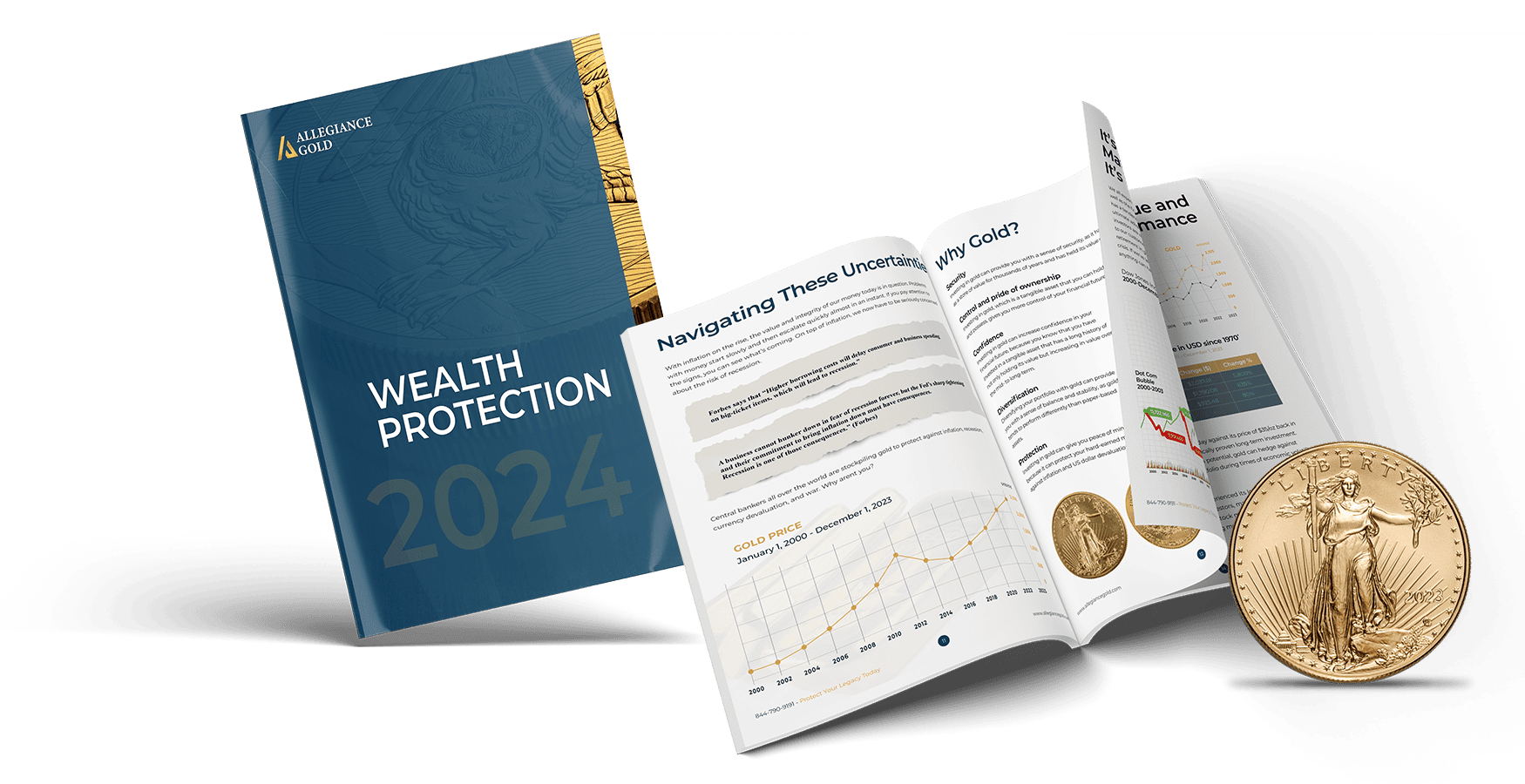

Gold as a Hedge Against Market Crashes: How Does Gold Protect Your Portfolio?
When stock markets fall sharply, investors often look for somewhere safer to put their money — and gold is one of the first assets that comes to mind. But how does gold protect against market crashes, exactly? Is gold really a reliable hedge, or is that reputation more myth than fact?
This article breaks down the historical relationship between gold and stock market downturns, the mechanics behind why gold often behaves differently than equities, and what a reasonable, balanced role for gold might look like in a diversified portfolio.
Why is Gold Considered a Safe-Haven Asset?
Gold has held value across centuries, currencies, and economic systems in a way few other assets have. Unlike a share of stock, gold isn’t tied to a single company’s earnings, management decisions, or debt load. It has no counterparty risk — meaning its value doesn’t depend on another party fulfilling a promise or contract, the way a bond or a bank deposit does.
That independence is a big part of why gold is often described as a “safe-haven” asset. When confidence in stocks, currencies, or the broader financial system wavers, some investors shift capital toward assets that exist outside that system entirely.
Does Gold Go Up When the Stock Market Crashes?
Gold’s performance during past market crashes has been far from uniform, but several notable periods illustrate why it has earned its reputation as a diversification tool:
The 2008 Financial Crisis: As the S&P 500 fell roughly 38% for the year, gold ended 2008 slightly positive, and went on to more than double over the following three years as investors sought stability amid the banking crisis and subsequent stimulus measures.
The Dot-Com Crash (2000–2002): While the Nasdaq lost more than 75% of its value from peak to trough, gold began a long upward climb that would continue for most of the following decade.
The COVID-19 Crash (2020): After an initial sharp selloff alongside equities in March 2020, gold recovered quickly and went on to reach new all-time highs later that year, as investors weighed unprecedented monetary stimulus and economic uncertainty.
It’s worth noting that gold doesn’t always move in the opposite direction of stocks, and it isn’t immune to short-term volatility of its own. In some crashes, gold has initially fallen alongside equities — often not because it lost its safe-haven appeal, but because investors scrambling to meet liquidity needs sell whatever they can most readily convert to cash. Gold is one of the most liquid assets an investor can own, and that liquidity cuts both ways: it means gold can be sold quickly when cash is genuinely needed, but it also means gold can get swept up in broad, indiscriminate selling during the sharpest moments of a panic, before recovering in the months that followed. The relationship is best described as historically low-correlated, not perfectly inverse.
Why Does Gold Behave Differently Than Stocks?
A few structural factors help explain gold’s tendency to move independently of stocks:
No earnings, no counterparty risk. Stock prices are ultimately tied to a company’s future profitability and the market’s confidence in that company. Gold has no earnings to disappoint and no board of directors whose decisions can erode its value.
Currency and inflation dynamics. Gold is often viewed as a store of value that isn’t tied to any single currency. During periods when a currency weakens or inflation erodes purchasing power, gold has historically been sought out as an alternative store of wealth.
Flight to safety. During acute market stress, institutional and retail investors alike often reduce exposure to risk assets and increase allocations to assets perceived as stable. Gold, along with other traditional safe havens like government bonds, has often benefited from this shift in sentiment.
Central bank demand. In recent years, central banks around the world have been significant, consistent buyers of gold, adding to reserves as part of long-term diversification strategies. This steady institutional demand is sometimes cited as a structural factor that supports gold’s price over time, somewhat independent of retail investor sentiment.
Gold Isn’t a Guarantee – It’s a Diversifier
It’s important to be clear about what gold is, and isn’t. Gold is not guaranteed to rise when stocks fall, and it should not be viewed as a way to eliminate risk entirely. Like any asset, its price can be volatile in the short term, and it can underperform during periods when equities are rallying strongly.
What gold has historically offered is low correlation to stocks — meaning its price movements haven’t consistently tracked the stock market’s ups and downs. For investors, that low correlation is valuable not because it guarantees gains during a crash, but because it can help smooth out overall portfolio volatility. A portfolio spread across multiple asset classes that don’t all move in the same direction at the same time tends to experience smaller swings than a portfolio concentrated in a single asset class.
This is the core principle behind modern portfolio diversification: it’s not about picking the single best-performing asset, but about combining assets whose risks partially offset one another.
Gold and Today’s Economy: A Real-Time Test Case (2026)
The current economy offers a useful, real-world illustration of why investors revisit diversification when the outlook gets murkier.
In its advance estimate released July 30, 2026, the Bureau of Economic Analysis reported that the U.S. economy grew at an annualized rate of just 1.5% in the second quarter — a slowdown from 2.1% in the first quarter. At the same time, consumer prices rose 3.5% over the year through June, still meaningfully above the Federal Reserve’s long-term 2% target, and the Fed’s preferred inflation gauge (core PCE) has been running warmer still.
Slowing growth paired with inflation that won’t fully cooperate is a difficult combination — for the economy and for the policymakers trying to respond to it. It’s the kind of backdrop that tends to make investors look harder at how their portfolios are positioned.
To be clear, none of this tells anyone what any single asset will do next; no one can know that. But it’s precisely the type of environment in which the case for owning assets that don’t all move in the same direction becomes easier to appreciate.
Questions Investors Are Asking Right Now
Why is the Federal Reserve holding interest rates steady? As of its July 2026 meeting, the Fed has held its benchmark rate in a range of 3.50%–3.75% for the fifth consecutive meeting. The challenge it faces is a genuine bind: the economy is slowing, which might ordinarily argue for lower rates, while inflation remains stubbornly above the 2% target, which argues for keeping rates elevated — or even raising them. Several Fed officials have publicly favored a hike. When the two halves of the Fed’s mandate pull in opposite directions, uncertainty for investors tends to rise.
What does slower growth plus sticky inflation mean for me? On its own, it doesn’t dictate any particular investment decision. What it does is highlight why a portfolio’s overall balance matters. Environments where growth and inflation are moving in uncomfortable directions at the same time are exactly when investors are glad to own a mix of assets rather than a single concentrated bet.
Does this mean now is the time to buy gold? That’s the wrong question to ask, honestly — and anyone who claims to know the perfect moment to buy any asset is guessing. The more useful question is whether your portfolio is diversified enough to weather a range of outcomes, including ones you didn’t plan for. Gold is one tool among several that investors use to pursue that kind of balance. Whether it fits your situation depends on your goals, your timeline, and your tolerance for risk.
How Much Gold Should You Have in Your Portfolio?
There’s no universal rule for how much gold belongs in a portfolio — the right amount depends on an individual’s risk tolerance, time horizon, and overall financial goals. Many financial professionals who recommend gold as part of a diversified strategy suggest allocations in the range of 5–10% of a portfolio, though this varies widely based on individual circumstances.
Investors typically gain exposure to gold in a few different ways: physical gold (coins or bars), gold-backed ETFs, gold mining stocks, or through a Gold IRA, which allows physical precious metals to be held within a tax-advantaged retirement account. Each approach comes with different trade-offs around liquidity, storage, fees, and tax treatment, and it’s worth understanding those differences before choosing one.
The Bottom Line: Is Gold a Good Hedge Against a Market Crash?
Gold’s long track record as a diversification tool comes from its structural independence from the stock market — no earnings risk, no counterparty risk, and a demand base that includes central banks and long-term reserve managers rather than just short-term traders. That independence has, historically, made gold a useful counterbalance during periods of equity market stress, even though it isn’t a guaranteed hedge in every scenario.
For investors thinking about how to build a portfolio that can weather market downturns, understanding gold’s historical role — and its limitations — is a useful starting point.
Frequently Asked Questions
Does gold always go up when stocks go down? No. Gold and stocks are historically low-correlated, not perfectly inverse. In some crashes gold has dipped first as investors sold assets to raise cash, then recovered in the months that followed. Its value is as a diversifier, not a guaranteed opposite bet.
Is gold a good hedge against inflation? Gold has historically been sought out as a store of value when inflation erodes a currency’s purchasing power. It is not a guaranteed inflation hedge in every period, but its independence from any single currency is one reason investors turn to it during inflationary stretches.
How much of my portfolio should be in gold? There is no universal rule. Many financial professionals who include gold in a diversified strategy suggest allocations in the range of 5–10%, though the right figure depends on your risk tolerance, time horizon, and financial goals.
What is the best way to invest in gold? Common options include physical gold (coins or bars), gold-backed ETFs, gold mining stocks, and a Gold IRA that holds physical metals in a tax-advantaged retirement account. Each differs in liquidity, storage, fees, and tax treatment, so the right choice depends on your goals.
Talk to a Precious Metals Specialist
If you’re considering how gold might fit into your own diversification strategy, a precious metals specialist can walk you through your options, including how a Gold IRA works and how it might align with your specific financial goals.
Call 844-790-9191 or visit This Link.
Disclaimer
This article is for informational and educational purposes only and does not constitute financial, investment, or tax advice. Economic data referenced reflects figures reported as of July 2026 and is subject to revision. Past performance is not indicative of future results, and all investments carry risk, including the potential loss of principal. Please consult a licensed financial advisor before making investment decisions.
To Start Your Gold IRA Today:
Download Your Free Gold IRA Guide | Open Your Gold IRA Account | Book Your Consultation
Protect your financial future with Allegiance Gold an Inc 5000 company– Your trusted partner in Gold and Silver IRA investments.
 |
 |
Buy Now |
Buy Now |
Act now and join the millions who trust gold to secure their wealth.

 Gold Products
 Silver Products
 Platinum