Is the Stock Market Overvalued? The Buffett Indicator Is Flashing a Major Warning
For years, investors have been told to “buy the dip,” trust the system, and stay fully invested in equities no matter what happens. That strategy worked remarkably well during one of the longest liquidity-fueled bull markets in modern history.
But as of May 2026, a growing number of valuation signals are raising uncomfortable questions.
Chief among them is the so-called Buffett Indicator — a metric legendary investor Warren Buffett once referred to as “probably the best single measure of where valuations stand at any given moment.”
And right now, that indicator is flashing levels historically associated with extreme market overvaluation.
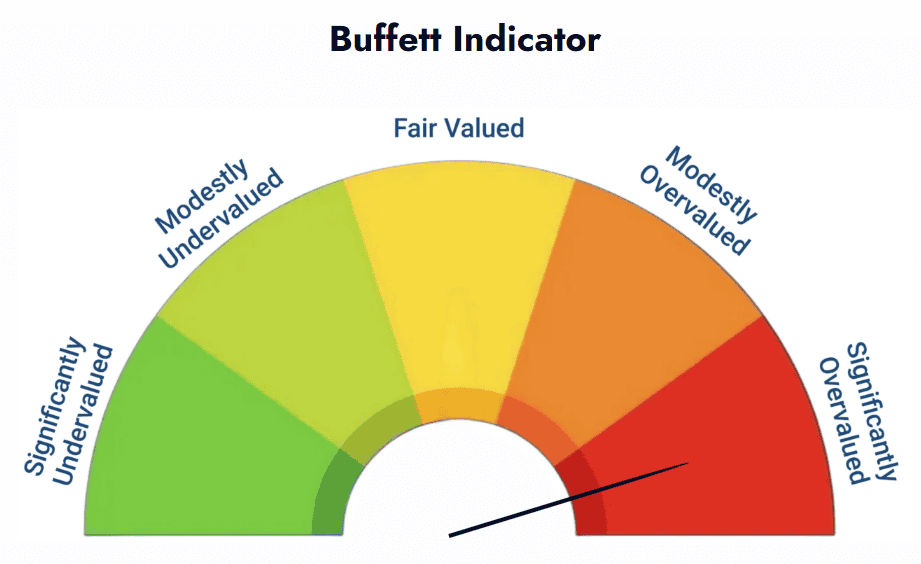
So, is the stock market overvalued?
A growing body of analysts, economists, and institutional investors believe the answer may be yes.
What is the Buffett Indicator?
The Buffett Indicator compares the total value of the U.S. stock market to the size of the U.S. economy, measured by Gross Domestic Product (GDP).
In simple terms, it asks a straightforward question:
Are stock prices growing faster than the economy that ultimately supports them?
The formula looks like this:
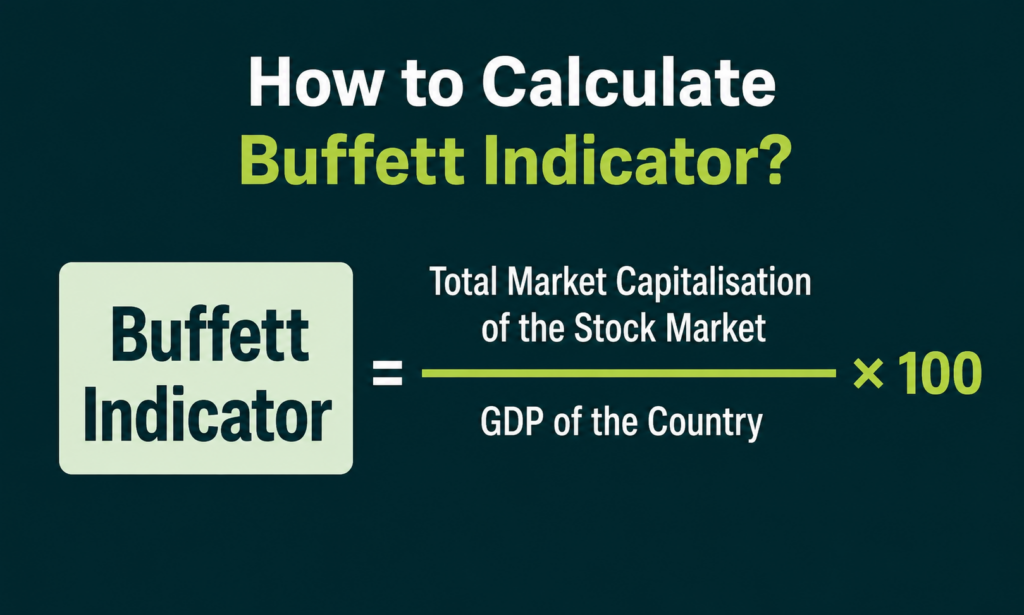
Historically, when the ratio climbs too far above long-term averages, future market returns have tended to weaken while downside risks increase.
During the dot-com bubble of 2000, the Buffett Indicator surged to record highs shortly before markets experienced a significant correction. Similar warning signs appeared ahead of the 2008 financial crisis.
Today, the indicator has once again climbed into historically elevated territory.
While no single metric can predict market movements with certainty, many analysts view the current reading as a sign that optimism may have outpaced economic fundamentals.
Why Valuations Matter More Than Ever
Valuations alone do not cause bear markets.
But elevated valuations can reduce the margin for error.
When markets are priced for perfection, even small disruptions can trigger outsized volatility:
- Slower economic growth
- Persistent inflation
- Higher interest rates
- Corporate earnings disappointments
- Geopolitical instability
- Expanding government debt
Each of these risks remains relevant in today’s environment.
Over the past decade, ultra-low interest rates and aggressive monetary stimulus helped push investors further into risk assets. That environment dramatically inflated valuations across equities, technology stocks, and speculative sectors.
Now, investors are facing a different reality.
Interest rates remain materially higher than they were during the easy-money era, borrowing costs have risen, and concerns about long-term fiscal stability continue to grow.
At the same time, market concentration has become increasingly extreme.
A relatively small number of mega-cap technology companies now account for a significant percentage of overall market gains. While these companies remain highly profitable, concentrated leadership can also create fragility beneath the surface.
If leadership narrows further or earnings expectations begin to soften, broader indices could become vulnerable to sharp repricing.
The Psychological Risk Investors Often Ignore
One of the greatest dangers during periods of overvaluation is complacency.
Late-stage bull markets often create the illusion that markets can only move higher. Investors become conditioned to believe that every correction is temporary and every dip represents a buying opportunity.
History suggests otherwise.
Market cycles are normal. Excesses eventually correct.
The challenge is that valuation extremes are often easiest to recognize in hindsight.
During the technology bubble, many investors believed traditional valuation metrics no longer mattered. Before the housing crisis, many assumed real estate prices could not decline nationally.
Today, investors once again hear arguments that “this time is different.”
Maybe it is.
But history has repeatedly shown that periods of elevated valuations tend to carry elevated risk.
What Happens if the Market Corrects?
No one can predict the exact timing or severity of a future downturn.
Markets may continue rising longer than many expect.
However, if valuations eventually revert closer to historical averages, investors heavily concentrated in equities could face meaningful volatility.
That reality is prompting some investors to revisit the role of diversification and defensive assets within a broader portfolio strategy.
Traditionally, assets such as cash, Treasury securities, gold, and silver have been viewed as potential hedges during periods of economic uncertainty or declining confidence in financial markets.
While these assets carry risks of their own, they are often evaluated differently from equities because they may respond to different macroeconomic conditions.
Why Gold and Silver Are Regaining Attention
In recent years, precious metals have re-entered the conversation among institutional investors, central banks, and individual savers alike.
Gold, in particular, has historically been viewed as a store of value during periods of monetary instability, inflation concerns, or financial stress.
Unlike fiat currencies, gold cannot be printed or created through monetary policy.
Silver, meanwhile, occupies a unique role as both a monetary metal and an industrial commodity used across technologies including solar energy, electronics, and advanced manufacturing.
That combination has caused some investors to explore precious metals as part of a diversified allocation strategy.
Importantly, precious metals are not guaranteed to rise during market downturns, nor are they suitable for every investor. Prices can fluctuate significantly, and past performance does not guarantee future results.
However, for investors concerned about elevated stock market valuations, inflation risks, or long-term currency purchasing power, gold and silver may offer diversification benefits worth evaluating alongside traditional financial assets.
Is the Stock Market Overvalued? Here’s the Bigger Picture
The question is not whether markets will fluctuate. They always do.
The real question is whether today’s valuations properly reflect underlying economic realities and future risks.
The Buffett Indicator suggests caution may be warranted.
That does not necessarily mean a crash is imminent. Markets can remain overvalued for extended periods. But historically, periods of extreme valuation have often been followed by lower long-term returns and higher volatility.
For investors approaching retirement, protecting accumulated wealth may become just as important as pursuing additional upside.
That is why many investors are beginning to look beyond traditional portfolios and reconsider the role of hard assets within a long-term strategy.
Final Thoughts
The current market environment presents both opportunity and uncertainty.
High valuations, persistent inflation concerns, rising debt levels, and shifting monetary conditions are causing many investors to ask difficult questions about risk exposure and portfolio resilience.
No asset class is without risk.
But in periods when financial markets appear stretched relative to economic fundamentals, diversification becomes increasingly important.
For some investors, that may include exploring gold, silver, and other precious metals as part of a broader strategy designed to preserve purchasing power and reduce overexposure to traditional financial markets.
Before making any investment decisions, investors should carefully evaluate their financial objectives, risk tolerance, and time horizon, and consult with qualified financial and tax professionals.
Disclaimer
This article is for informational and educational purposes only and should not be construed as investment, legal, or tax advice. Investing involves risk, including possible loss of principal. Past performance does not guarantee future results. Precious metals are speculative and may not be suitable for all investors. Always conduct your own due diligence and consult a qualified financial professional before making investment decisions.
To Start Your Gold IRA Today:
Download Your Free Gold IRA Guide | Open Your Gold IRA Account | Book Your Consultation
Protect your financial future with Allegiance Gold an Inc 5000 company– Your trusted partner in Gold and Silver IRA investments.
 |
 |
Buy Now |
Buy Now |
Act now and join the millions who trust gold to secure their wealth.

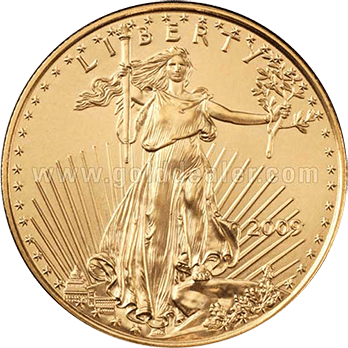 Gold Products
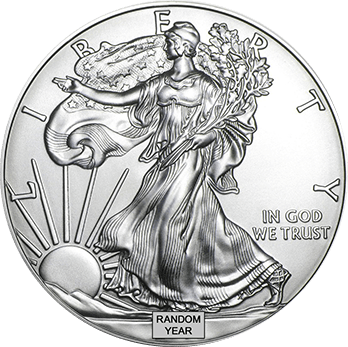 Silver Products
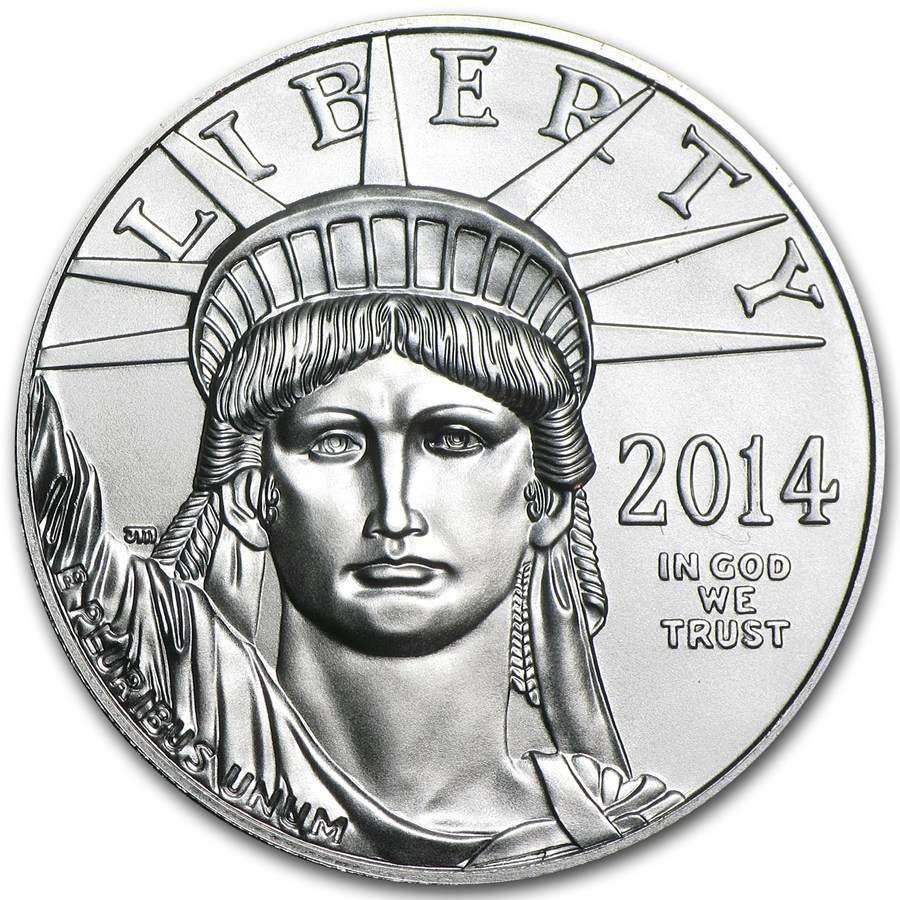 Platinum